Where your first clients actually come from
Sep 08, 2026
Where your first clients actually come from
You have done the training. You have the certificate, the modality, the hours. You know the work changes people because you have watched it change you.
And you have no clients.
So you build the website. You learn reels. You buy another marketing course, then a second one, and you post consistently for four months into a room with nobody in it. Then one morning you think, maybe nobody wants this. Maybe my niche is too small. Maybe I am not good enough at it yet.
I have mentored a lot of practitioners through this exact moment, and I want to tell you what is really going on.
You have opened a shop and never turned the lights on.
The three circles
There are three groups of people around your business.
Circle one is everyone who already knows you. Old colleagues, school parents, the people you trained with, family, the woman you met at that breathwork weekend, clients you had in a completely different line of work.
Circle two is the people those people know. You cannot see this circle. It is much bigger than circle one, and you only ever reach it through circle one.
Circle three is strangers. People who find you through search, ads, social media, someone else's podcast.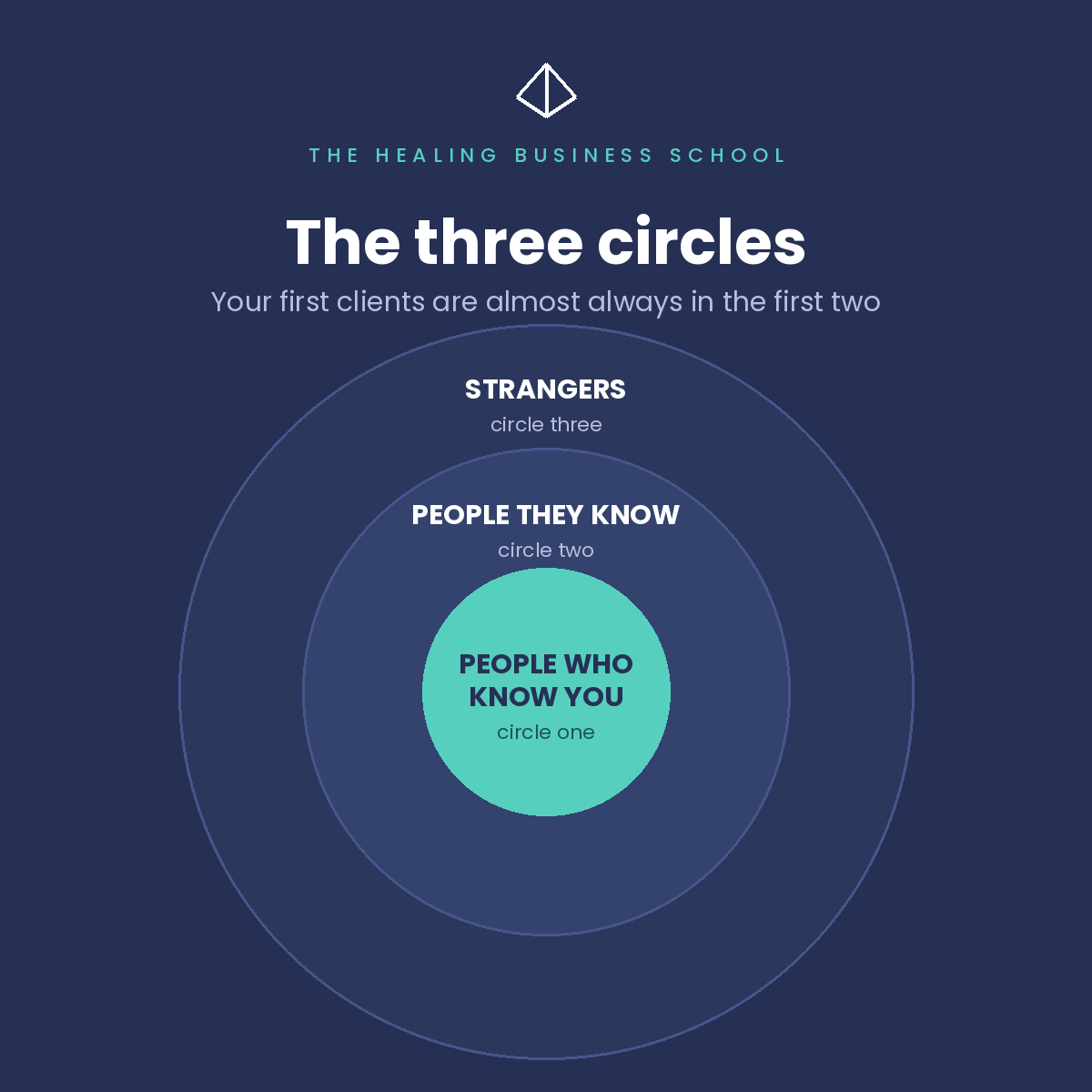
Almost everybody starts by pouring all of their energy into circle three, which is the hardest, slowest, most expensive circle there is. Meanwhile your first five or ten clients are sitting in circles one and two, where they almost always are.
Here is the part that stings a little. Most of circle one does not actually know what you do now. They might know the name of your modality, but if you say you work with the subconscious, or you offer Reiki, or Ho'oponopono, or human design, a lot of people are just hearing words. They know what you used to do. They have watched you post sunsets and holidays, and this new thing you are becoming has not landed for them yet.
That is not a marketing problem. That is a "nobody has been told plainly" problem, and it is very fixable.
Why asking feels like taking
Before the steps, the thing underneath them.
When I asked our community what they most wanted to shift, over a thousand people answered, and the same thing came back in different words. One wrote that she feels ashamed to ask for money for something she does easily. Another said she is petrified of asking, because she has only ever had money land in her account from a payslip, never had to ask a person for it directly. One wanted to attract clients in a way that feels safe for her nervous system.
And one line I have not stopped thinking about, from someone who wants to build a business that is a corrective experience rather than a retraumatising one.
If asking for money feels like taking, that is almost never a business problem. Somewhere earlier you learned that needing something makes you a burden. Maybe you were the easy child. Maybe fawning was what kept things calm. Maybe money was tight and asking made it worse, or you watched someone ask and get humiliated for it.
So your system built a sensible rule. Do not ask. Be useful, be lovely, and hope somebody notices and offers.
That rule protected you once. It is now standing between you and the work you are here to do, and it was never yours to begin with. You can hand it back.
Because an offer is not pressure. An offer is information. You are telling someone that a door exists. They get to decide whether they walk through it, and they are allowed to say no.
Step one. The twenty names
Get a pen and paper. Write down ten to twenty people you know who would be at least a little open to this kind of work.
Not who can afford it. Not who you think will say yes. Do not filter, because filtering is fear doing your thinking for you. Scroll your recent messages if you get stuck.
Then sort them into three groups. Who might need this now. Who knows a lot of people. Who has always cheered for you.
Start with the open ones. Not the person you would have to intellectually prove something to. You are building evidence for your nervous system here, so give it something easy first.
Step two. Send five messages
One at a time, personal, no graphics, no launch announcement, no paragraph about your modality. Four parts:
What you are doing now. Why you thought of them. That you are just starting and would love their support. Then one question: are they interested, or do they know someone who might be.
Something like this.
I have started taking clients for this work and I am so excited about it. I thought of you because of what you mentioned about your sleep. I am just starting out and building my practice, so I would really appreciate your support. Would you like to hear how it works, or is there anyone you know who might?
That is the whole message. It is honest that you are beginning, which people respond to far more warmly than practitioners expect. And it gives them two doors, so a no to the first is not a no to you.
Now, before you send anything, know how this goes. One or two people will be flat. Someone might make a joke about it.
When I changed my life, some of my close friends took a long time to come around, and a few said some pretty horrible things. It was not a sign. They knew who I used to be, and they had no framework for who I was becoming.
They are simply not your people. You are not saying the wrong thing, you are saying it to the wrong person, and there is an enormous difference between those two.
Things will come up while you send them. Heat in your chest. The urge to rewrite it eleven times, or put the phone down and go and do the washing. That is your nervous system doing exactly what it was built for, which is protecting you from being seen. It is not a sign you are not ready.
So connect to your message rather than to yourself. This stops being unbearable the moment it is not about you. There are people waiting for what you carry.
Step three. Tell your story on your own page
This is how I got my first clients. There was no strategy. I told people what had happened to me and what I had found on the other side of it, and I kept telling it on my personal page. I had no business set up. Nothing.
Your story is the marketing. Almost nobody books a modality. They book someone who has been where they are and got out, because when you are in it, that is the only evidence that counts.
Post where you were, what you tried, what actually shifted it, and what you do now. Then one plain line at the end saying you are taking clients and how to reach you.
Not a highlight reel, and not your wounds on display. The middle version, told from the other side.
And if you do not have the lived experience but you have deep training in an area you love, that works just as well. What matters is that you know how to get someone to the other side, right?
Step four. Go where your people already are
Somewhere on Facebook, or in a community you are already part of, there is a room full of people living the exact thing you came through. Sober curious. Single mums. Chronic pain. Postnatal. Grief.
They are in the middle of it right now, asking their questions out loud.
Go and be in that room. Read the group rules and follow them. Answer questions properly and generously, for free, as the practitioner you already are. When someone asks something you know, give them the real answer, not a teaser designed to make them come and ask you for more.
You are not farming that group. These are your people, and you would be helping them anyway, right? Where the rules allow it, say plainly that you take clients. Where they do not, be helpful and let your profile do the work.
Step five. Offer something small and free
A free consultation. A quick energetic reading. A short class. A twenty minute chat. Even a PDF.
With this work, people cannot evaluate you from the outside. They cannot tell from a website whether they will feel safe with you. They need to hear your voice and feel your nervous system for a few minutes.
Two rules so this does not eat you alive. Keep it small and time boxed, and make sure there is a clear next step at the end, which is your offer and your price.
A small free taste is not the same as working for free.
Step six. Charge something, even if it is small
Nearly every practitioner I have mentored wanted to do their first ten clients for free. I understand why. Free is safe. Nobody can be disappointed, nobody can ask for their money back, and you never have to find out what your work is worth.
But free costs you both.
When there is no exchange the client does not commit. They cancel the morning of. They do not do what you gave them between sessions. They arrive half in the room. Not to be rude, it is simply that we show up for what we have invested in.
And it teaches your own system that this work is a favour rather than an exchange, which is very hard to unlearn later.
So charge, even if it is small, and say it neutrally. This is my starting rate while I build my practice. Give it an end point, either a number of clients or a date, so raising it later is something you already announced.
Then ask for two things. A testimonial, written or video, with three questions so they are not staring at a blank screen: what was going on before we worked together, what happened in the session, and what would you say to someone thinking about it. And then, who else do you know who is dealing with this.
Most practitioners never ask that second one, which is why their referrals stay accidental.
Your one thing this week
Message five people.
Not twenty. Five. Personally, one at a time, in whatever way your body can manage. If it says no when you go to press send, that is the exact moment the work is happening. Send it anyway, or send one and stop for the day. Both are progress.
Then over the following weeks, in this order: post your story, find two to four groups and start showing up, put your small free thing out. One at a time. All four at once is how people burn out by week two.
Come and do this with us
Everything above is one lesson inside The Healing Business School.
It is a soul led, trauma informed business school for coaches, therapists and healers who are brilliant at holding space and were never taught how to build the business around it. Inside is the full training on getting your first clients, weekly live coaching calls, a global community of practitioners at every stage, and monthly Akashic readings on your business.
It is $150 a month, or $1,500 for the year, and there is a seven day free trial. So you can come in, watch this whole training properly, and decide afterwards.
It is not for you if you want a script to run at people. It is for you if you want to build something that holds your work and does not cost you your nervous system to run.
Thank you for reading this far, and thank you for the work you are doing. You went through what you went through, and you have turned it into something that helps other people through theirs.