
When the Human–Animal Bond Holds More Than Behaviour
Apr 27, 2026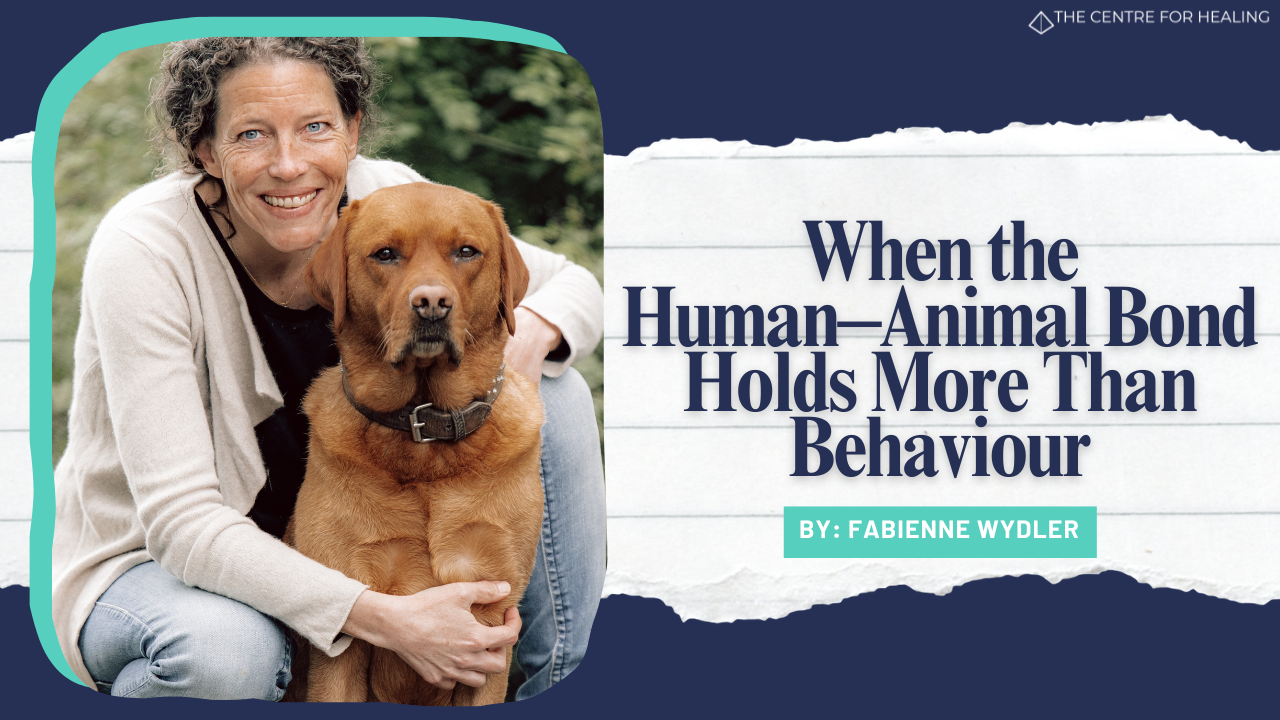
You do everything that seems right with your animal and still feel that something essential is missing.
You work on the reactivity, create more structure, and pay close attention to timing, consistency, boundaries, and support. But the same pattern keeps returning.
That is usually the moment when I begin to wonder whether the issue is really only behavioural.
Because often, it is not.
An animal is responding not only to what is happening around them, but also to what is happening within the bond they share with their person. Some of this may be obvious. After a stressful day at work, tension in the home, or visits who disrupt the usual rhythm, an animal may react to stress with behaviour.
But what I am referring to here is something more subtle: the emotional tone carried underneath the surface, perhaps chronically, but not yet fully recognised or named. It may be tension that has become normal. Fear that has never fully settled. Grief, vigilance, pressure, or inner conflict quietly shaping the relationship from underneath.
And when that hidden layer is part of the picture, the visible behaviour does not
always tell the whole story.
Where the hidden layer begins to show
Again and again, I see animals express something their person has not yet fully recognised in themselves.
A dog who becomes overprotective or reactive may be responding to a nervous system that has learned to scan, anticipate, and brace. A dog who clings may be part of a relationship in which closeness and safety are more fragile than they appear on the surface.
This is because both beings are part of the same relational field, constantly affecting and responding to one another. It is within this relational pattern that deeper inner beliefs often take shape and begin to emerge.
Those beliefs are often older than the present situation. They are usually shaped by earlier experiences that taught the body what to expect from connection, safety, and belonging.
They may sound like this: I have to hold everything together. It is not safe to relax. I will be left. I have to adapt in order to belong. My needs create disconnection. Love is not steady. Closeness is uncertain. And because beliefs like these do not live only in thought, but in the body, they influence how a person relates long before they consciously put them into words.
HAVE YOU GOT THE ULTIMATE TRAUMA THERAPY CHECKLIST YET??--
What seems obvious is not always the full story
Let me explain this with a woman who once came to me because her dog could not be left alone.
Whenever she went out, he would bark, whine, and sometimes destroy things in the apartment. She wanted help for him. That was the obvious focus. His behaviour had become difficult and stressful for both of them.
One of the first things I asked was how often, and for how long, she left him alone.
She told me: quite often. Not because she wanted to, but because she felt she had to.
As we spoke more, the wider context came into view. The man she was dating was not particularly interested in her dog. When she was invited to dinners or barbecues, people often asked her to leave him at home. Her group of girlfriends preferred making plans that did not include dogs.
Again and again, she found herself in the same position: having to choose between belonging and honouring what felt true to her bond with her animal.
She felt sad about it but also pressured. Pressured not to make too much of it. Pressured to be easy. Pressured to adapt. Pressured to leave her dog behind in order to remain included.
As we stayed with that, something deeper came into focus. The distress she felt around leaving her dog was not only about him. It was also touching something much older in her: a place that knew what it meant to feel left, and to learn that belonging sometimes required self-abandonment.
That was the point where the dog’s behaviour started to read differently.
What looked like separation anxiety was also entangled with her own unresolved experience of separation and belonging. Her dog was not inventing the charge in the bond. He was responding within it.
As this woman allowed herself to feel the sadness, fear, and anger underneath, something in her began to reorganise. She saw more clearly how often she had overridden herself in order to stay connected. She became more honest about where her needs had become negotiable. And from there, her choices in the present began to change as well.
She cancelled some dinners and social plans where her dog was not welcome. She stopped forcing herself into spaces that required her to split off from what mattered to her. She began choosing differently. More truthfully. More in line with herself and with the bond she had with her dog.
What changed next was striking, but not surprising.
Her dog calmed down very quickly. The pattern within the relationship had shifted.
Her dog had not only responded to the immediate situation, but also to the emotional
reality held within the bond itself.
Want to work with us?
If you're a Coach, Therapist, Healer or Someone in the Industry CLICK HERE
Want to Deepen your own Healing Journey or become a Practitioner CLICK HERE
When reactivity is carrying more than reactivity
I see something similar with reactivity and overprotectiveness.
Finni, a yellow Lab, reacted strongly on walks, scanned the environment, and stayed intensely alert around other people. At first, Finni appeared to be the one carrying the problem. And of course, she was carrying something real. But it soon became clear that the charge in the situation did not begin with the dog alone.
Sometimes the person is living with an underlying state of vigilance themselves. Not dramatic, perhaps. Not always conscious. But present. A body and nervous system that does not fully soften or know how to relax. A system that expects intrusion. A person who feels responsible for keeping everything safe.
In that kind of bond, a reactive or overprotective dog can begin to make profound relational sense.
In behavioural form, Finni was expressing a level of activation her person had been living with internally for years. Not because her human had “caused” the dog in a simplistic way, but more because Finni was part of the same relational system of regulation, protection, and response.
As her person began to process what sat underneath his own watchfulness, fear, and bracing, Finni no longer needed to carry that role with the same intensity.
And this is where the deeper significance of the work begins to show.
Once that underlying layer is addressed, the process becomes much more than trying to improve behaviour. It becomes a movement toward truth inside the relationship.
A more relational way of understanding the bond
None of this means that every behavioural issue is a mirror, or that the human is the reason their animal is struggling. That would flatten something far too complex.
Animals have their own experiences, bodies, histories, and sensitivities, and they
deserve to be understood in their own right.
But there are many moments in which the behavioural lens, on its own, is not
enough.
When that happens, a more relational perspective becomes not only useful, but
necessary.
Instead of asking only, How do I fix this behaviour? a different set of questions
begins to open up:
What is my animal responding to here?
What is being carried in this bond?
What in me has not yet been fully met, processed, or brought into awareness?
In my experience, that is often where healing begins. Because sometimes what looks like behaviour is also relationship, history, adaptation, and survival. Once that becomes visible, the path to healing changes completely.
Connect and Explore Further
To learn more about my work, sessions, and approach, visit:
www.fabiennewydler.com
You can also join my Soul Bond Circle, a free meditation space for people and their
animals, created to support safety, connection, and deeper attunement within the
bond: https://www.fabiennewydler.com/free-meditations-heal-with-animals
Follow along here:
Instagram: https://www.instagram.com/healwithanimals/
TikTok: https://www.tiktok.com/@healwithanimals
YouTube: https://www.youtube.com/@healwithanimals
Explore our courses and trainings at The Centre for Healing HERE