
You know where it started. So why are you still stuck?
Oct 30, 2026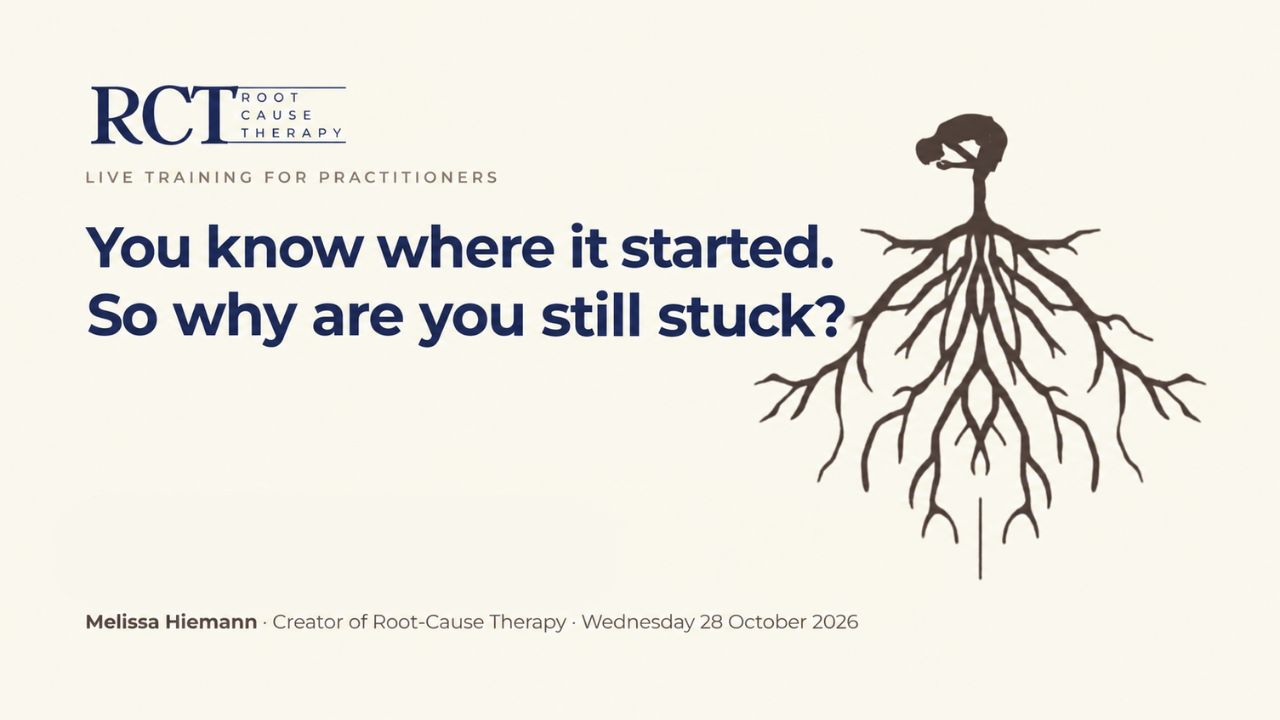
What Root-Cause Therapy does differently, from Melissa's live class on healing trauma at the root.
Most of us can name our patterns by now. We know why we pull away when someone gets
close, why we snap at the people we love, or why we quietly hold ourselves back at work.
Often we can trace it to a specific memory.
And still the pattern keeps coming back.
This week Melissa Hiemann, creator of Root-Cause Therapy (RCT), taught a free live class
on exactly this question, to practitioners joining from all over the world. Here's what she
shared about why insight alone often doesn't shift trauma, and what changes when the
work goes to the root.
Trauma is defined by what the event left behind
Melissa opened with a line from her book: trauma isn't defined by the event itself. It's
defined by what the event left behind.
That's also why she asks practitioners never to compare one person's trauma with
another's. Two people can live through the same thing and carry very different things away
from it, depending on their history, their family, their culture and the state of their nervous
system at the time. What looks small from the outside can be just as overwhelming for the
body that lived it.
The weed in the garden
To explain why some patterns keep returning, Melissa uses a weed.
• The leaves are our thoughts. The ones we notice, replay and talk about.
• The branches are our behaviours. The patterns that hold those thoughts in place.
• The stem is our beliefs. Often black and white: I'm not safe. I'm not good enough.
• The roots are the original moments. Family, culture, early experiences, and sometimes
what was carried down from generations before us.
A lot of therapy works with the leaves, by talking through thoughts. Some works with the
branches, by interrupting patterns or using willpower to change a behaviour. Both can help.
But anyone with a garden knows what happens when you trim a weed and leave the root in
the ground. It grows back.
Melissa adds one more thing. Many weeds are medicinal. Pulled out slowly and carefully,
they leave something useful behind: the learning, and the growth that can come after
trauma. That's the difference between ripping a pattern out and actually healing it.
Why the root stays in the ground
When something overwhelming happens, the body's stress response is meant to run its
course and settle. A deer that escapes a predator shakes it off once it's safe, and its system
returns to baseline.
But when we're too young, too alone, or too dependent on the person causing the threat,
that cycle can't finish. The emotion is held in the body, waiting until it's safe to release. And
a belief forms around it, encoded as truth, to stop us getting hurt the same way again. If the
threat came from a man, the nervous system might conclude that all men are unsafe. It's
protection, and it can limit a whole life.
Melissa describes these unfinished emotions as sealed in glass straws. We guard them
without realising. We reach for rage so we don't have to feel shame. We pull away so we
can't be rejected. We keep life small so nothing touches them. Held in safety, the straws can
finally drain.
This is also why insight isn't enough. These experiences sit in implicit memory, in the
deeper parts of the brain, below conscious thought. You can't always talk your way down to
them. Clients often go into the story of what's happening now, because the root isn't
somewhere they can consciously reach.
“It's not always the root cause.”
M E L I S S A H I E M A N N
HAVE YOU GOT THE ULTIMATE TRAUMA THERAPY CHECKLIST YET??--
Same symptom, different root
Two clients can arrive with the same anxiety and need completely different work. One
grew up in a home that never felt safe, and their body has been braced ever since. The
other has a safe home now, and a fear that began generations before they were born.
Trauma can sit at many layers: in the womb or at birth, in the pre-verbal years, in
childhood, in adulthood when support wasn't there, or in the family line. If the work isn't
matched to where the root actually is, nothing moves. As Melissa put it, that's not because
the client isn't trying hard enough, or because the practitioner is failing them.
So Root-Cause Therapy doesn't assume. Every belief is tested against the client's own body
before it's worked with, and tested again afterwards. The practitioner doesn't decide where
the root is. The client's body does.
What healing at the root looks like
An RCT session follows a clear arc. It starts with intake and a single testing sheet that
tracks the client's emotions, beliefs, behaviours and what they need to feel safe. The client's
own body and unconscious mind choose what's ready to be worked on. From there, the
practitioner guides them back to the first event, and the emotion that got stuck there is felt
and allowed to complete, gently and at the client's pace, with a safety resource close by.
Nothing is deleted or reframed before it's felt. Melissa is firm on this. Reframing pain too
early can leave people more disconnected than before. Release comes first. The new
perspective, and often a sense of compassion for the younger self, arrives on its own once it
has.
And because the work happens at the first event, the similar events linked to it can shift
too. Clients don't need to go back through every painful memory one by one. That's why
RCT is used with complex, repeated trauma, and not only single events.
Melissa is equally clear about scope. RCT practitioners hold space and follow the client's
lead. Anyone in active crisis, including suicidal thoughts or psychosis, is referred on.
Four sessions, tracked
Melissa shared one client's testing sheet from a real session, with the client's permission.
In session one, her stress was 9 out of 10 and her sense of abundance was 2. Money worries
were running her day, and she was smoking five cigarettes a day. Her body pointed to the
belief "I don't have enough money", and the root sat three generations back, with her nan,
who didn't know how she was going to feed her kids.
Once that old fear was allowed to finish, something shifted. Her finances hadn't changed,
but her stress about them had. She had more capacity to figure things out, instead of
freezing.
By session four, her stress was 4 and her abundance was 7. She had stopped smoking. Every
one of those changes sat on one sheet she could see for herself.
Melissa built the testing sheet because of her own time as a client, repeating herself week
after week and never sure if anything was changing. With RCT, clients see their progress,
and practitioners know exactly what to work on next.
Bo and Lani
Two Root-Cause Therapy practitioners joined the class live to share their own stories.
Bo thought she'd done every therapy there was. Then losing both of her parents brought 25
years of old pain straight back, along with a weight of guilt and shame. After six RCT
sessions, the guilt and shame were gone, and the healing reached her daughter too. In her
words, there is a before and after.
Lani had tried talk therapy and retreats. Her body felt so unsafe she couldn't sleep, and the
same unsafe relationships kept repeating. After her first session, she said she could breathe
again. Today she has friendships built on love and respect that go both ways.
Both went on to train as Root-Cause Therapy practitioners, so they could offer their own
clients the same relief.
Want to work with us?
If you're a Coach, Therapist, Healer or Someone in the Industry CLICK HERE
Want to Deepen your own Healing Journey or become a Practitioner CLICK HERE
Five things to take into your practice
Whether or not you train in RCT, Melissa left the class with five things any practitioner can
use:
1. Ask what the symptom is saying. What would need to heal for it to stop needing to speak
up?
2. Start with the body, not the story. Where is it felt? Follow the sensation before the
explanation.
3. Ask how old the reaction is. A reaction bigger than the moment often belongs to a
younger self.
4. Release before you reframe. Let the feeling finish first. The new perspective comes from
within.
5. Track the changes. Simple ratings, session to session, make healing visible for you and
your client.
“Understanding takes away the fear.”
M E L I S S A H I E M A N N
Learn Root-Cause Therapy, half price until Monday
Root-Cause Therapy certification is 50% off until midnight Monday 2 November
(AEDT).
• The full method step by step, including the testing sheet and healing scripts
• Intake forms, client forms and email templates
• Business and marketing training
• Lifetime monthly supervision with Melissa, and lifetime access to the materials and
updates
• International accreditation and 96 CPD credits
• Self-paced, with a global community of practitioners
RCT can sit alongside a qualification you already hold, or stand on its own if you come
to this work through lived experience.
Enrol at half price: https://www.thecentreforhealing.com/root-cause-therapy-certification-1
If you'd rather experience a session first, you can find a qualified Root-Cause Therapy
practitioner in our practitioner directory.