
What's Your Healing Style?
Jun 28, 2026
Just like your attachment style shapes how you relate to others, your Healing Style shapes how you naturally show up when someone needs to heal — whether that’s a client, a friend, or yourself. It’s the instinct you reach for first: the questions you ask, the things you notice, the kind of presence you bring into the room.
Here’s what we see again and again in our practitioner community: the ones who burn out fastest are rarely the ones doing “too much.” They’re the ones doing the wrong kind of work for who they are — forcing themselves to be the calm, still presence when their gift is fast, hands-on intervention. Pushing for deep root-cause questions when their gift is reading the body. Borrowing someone else’s healing style instead of trusting their own.
Knowing your Healing Superpower isn’t a personality quiz for fun — it’s permission. Permission to stop trying to be every kind of healer at once, and start becoming brilliant at the one that’s already yours.
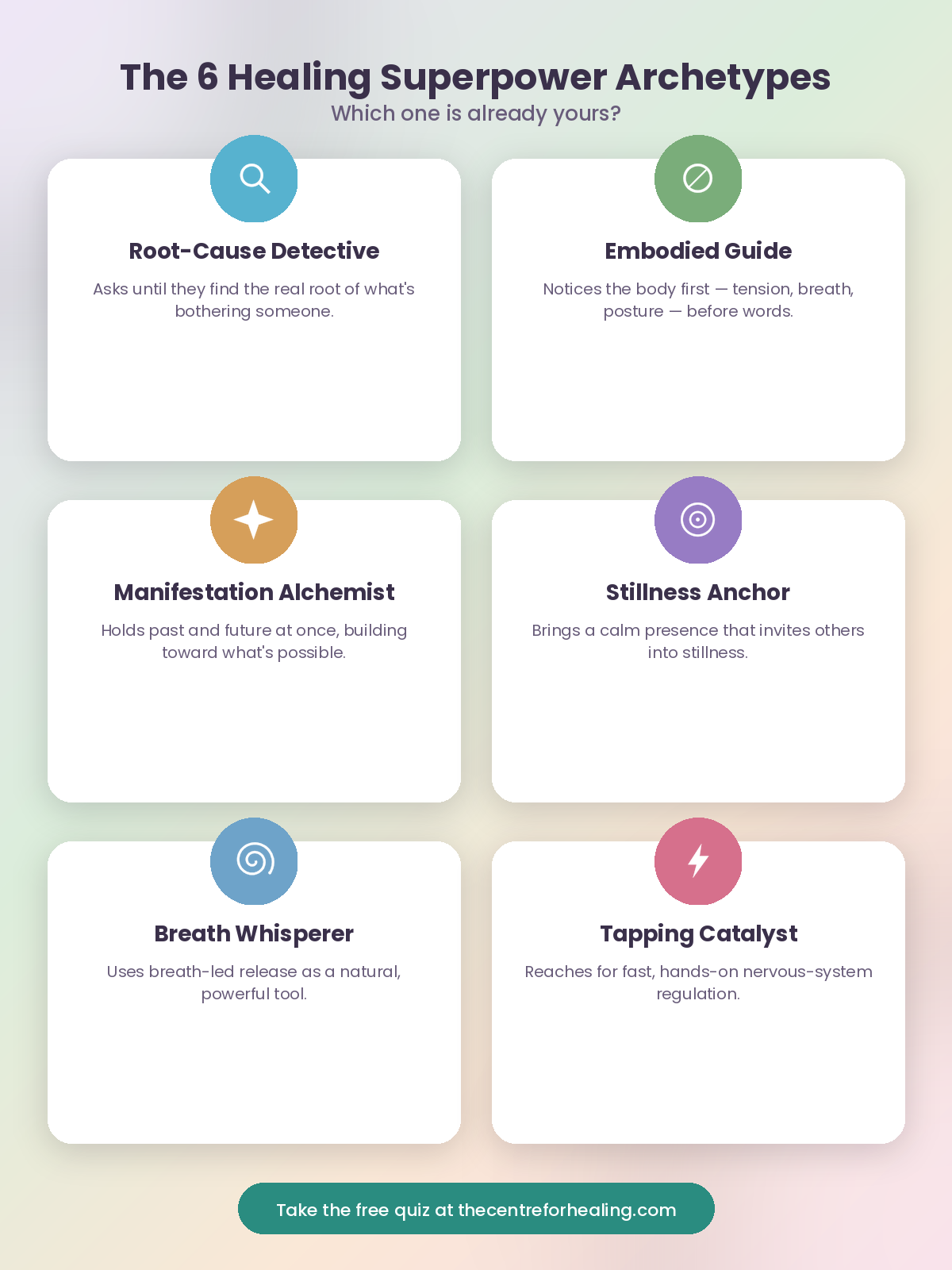
There are six Healing Superpower archetypes we see again and again in trauma-informed practitioners:
1. The Root-Cause Detective — You ask questions until you find the real root of what’s bothering someone. You’re not satisfied treating symptoms; you want to know why the pattern started in the first place — then the healing moves fast.
2. The Embodied Guide — You notice the body before the words. Are they tense? Holding their breath? Fidgeting? You work slowly, following the body’s own signals rather than rushing the mind.
3. The Manifestation Alchemist — You hold past and future at once. While you help people process what happened, you’re equally focused on what’s possible next — building toward a vision, not just fixing what’s broken.
4. The Stillness Anchor — You’re the calm in the room. Without trying, your presence invites people into stillness — a rare gift in a world that’s almost always overstimulated.
5. The Breath Whisperer — You know how powerful something as simple as breath can be. Breath-led release work is your natural tool, and sometimes one session changes everything.
6. The Tapping Catalyst — You want tools that work right now, in the moment. Fast, hands-on regulation — tapping, acupressure, nervous-system resets — is where you shine.
Why honouring your style matters more than you think
When you work from your natural style, healing work feels sustainable instead of draining. You’re not performing a technique you read in a book — you’re working from instinct, which means you can go deeper, stay present longer, and recover faster between sessions.
It also makes you a better practitioner. Clients can feel the difference between someone delivering a borrowed method and someone working from their genuine gift. Your style isn’t a limitation — it’s the thing that makes your work yours, and that authenticity is what people trust.
And practically speaking, it points you toward the right training. Rather than choosing a certification because it’s popular or because someone you admire teaches it, you can choose the path that matches how you’re already wired to help — which means you’ll actually finish it, love it, and use it for years to come.
None of the six styles is better or worse than another — each is a genuine gift, and most practitioners are a blend with one clear lead. (If you’ve taken our attachment style quiz, this works the same way: knowing your pattern doesn’t box you in, it just tells you where to start — and gives you permission to stop apologising for the rest.)
Once you know your archetype, the next step is training in the modality that’s already your instinct — rather than forcing yourself into a framework that fights your nature. You can see all of our trauma-informed certification pathways here.
Discover My Healing Superpower →
Quiz recommendation:
In peace,
The Centre for Healing Team