
You Can Know Exactly Where a Pattern Started and Still Not Be Free of It
Oct 21, 2026
Picture a client who has read every book on attachment.
She can tell you exactly why she pulls away the moment someone gets close. The dad who left when she was six. The promises that were never kept. She can explain it beautifully.
And the next time someone kind turns up, her chest tightens and she still finds a reason to leave.
If you work with clients, you've probably met her. You might have been her. So why does knowing where a pattern started so often fail to set us free?
Insight lives in one place. The pattern lives in another.
None of this means the client isn't trying hard enough, and it doesn't mean the work she's done was wasted. Understanding our history is valuable. It just isn't the whole story.
Awareness lives in our thinking mind. The pattern lives somewhere else entirely: underneath language, in the deeper parts of the brain, in the nervous system, and sometimes in experiences from before we could even speak.
When something threatening happens, the nervous system responds before we have time to think. We fight, flee or freeze. Then, once the threat passes, the body is meant to discharge that activation and settle back to baseline.
But sometimes the cycle can't complete. We're too young, too alone, or too dependent on the very person causing the threat. So the body holds onto it, waiting for a time when it's safe to let go.
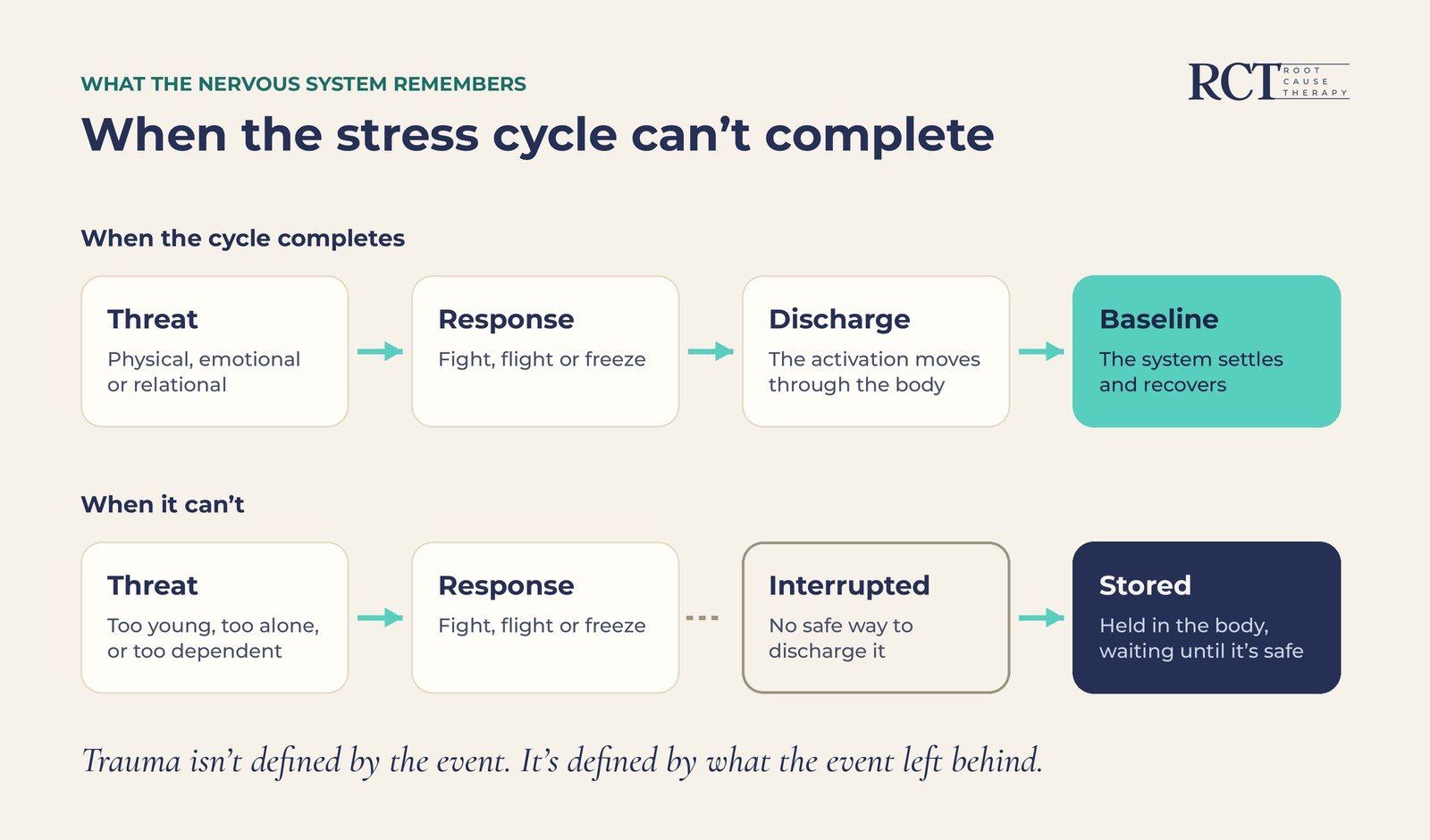
That stored activation is what we're working with. In Root-Cause Therapy we say it simply: trauma isn't defined by the event. It's defined by what the event left behind.
Same symptom, completely different root
This is where so much healing work falls short, and it's not anyone's fault.
Two clients can walk in with the same anxiety. One is carrying a nervous system that has been braced since a childhood home that never felt safe. The other is carrying fear that started generations before they were born.
Same symptom. Completely different root. And a completely different path to healing it.
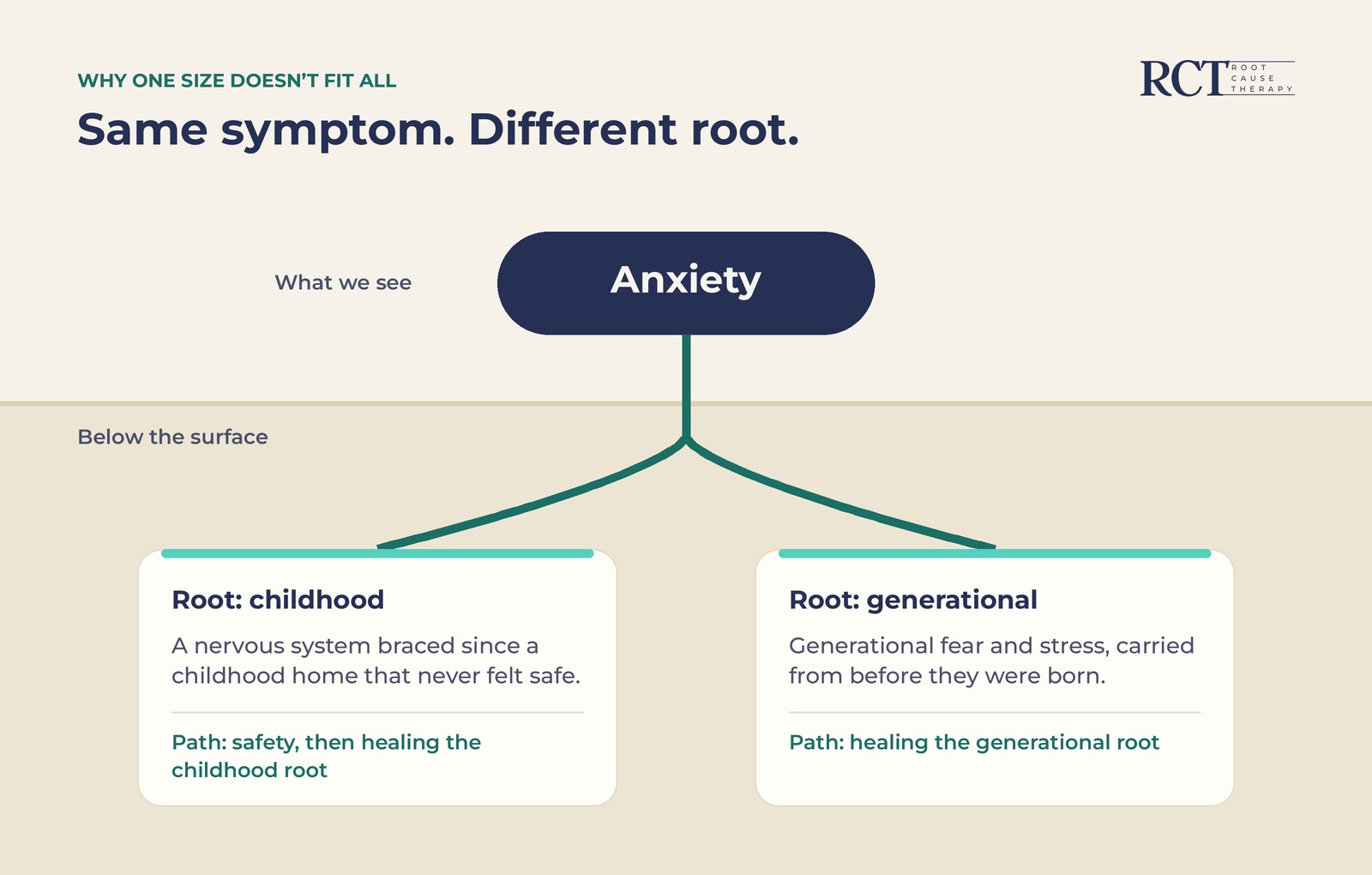
Trauma can be held in the womb, at birth, in childhood, and across generations. Research on intergenerational trauma and epigenetics is helping us understand how stress responses can be carried down family lines. Every client holds it differently, which is why one-size-fits-all approaches so often plateau. The work just hasn't been matched to the person yet.
Symptoms are messengers
Some trauma responses are easy to recognise: anxiety, hypervigilance, emotional reactivity. Many aren't.
Procrastination. Self-sabotage. Bracing every time someone gets close. Keeping small and not going for the goals that matter. Physical symptoms that don't have a clear cause. Compulsions that no amount of willpower can shift.
These aren't character flaws. They're the nervous system doing its job, protecting someone from a pain it learned to avoid a long time ago.
When a client understands that their anxiety isn't proof that something is wrong with them, but a sign that something unresolved is trying to speak, everything changes. Shame turns into curiosity, and curiosity is where healing starts.
Three things you can bring into your sessions this week
Whatever modality you work in, these will help.
- Build safety before you go anywhere deep. Ask your client where in their body they feel even a little peaceful or safe. Come back to that place whenever things get big. The body only allows the healing it has capacity for, so capacity comes first.
- Listen for the repeat. When the same dynamic keeps turning up in different relationships, workplaces or decades, it's rarely bad luck. It's often trauma reenactment: a part of the client seeking resolution. Name the pattern gently, without blame.
- Track something you can measure. Ask your client to rate one thing out of 10 at the start of every session, such as how safe they feel in their life right now. Watching that number move builds trust, especially for analytical clients who need to see change before they believe it.
We don't guess. We track.
That third point is the heart of how we work in Root-Cause Therapy.
Every client has one testing sheet that follows them from session to session. It shows where the trauma sits for them, how their mind has categorised it, and what their system needs in order to release it.
So you always know where you are, what's shifted, and where to go next. There's no starting from scratch each week and no wondering whether it's working. Your client gets clear progress, and you get confidence as their practitioner.
Join me live on 28 October, and earn 2 CPD credits
On Wednesday 28 October, 10:00 to 11:30 am AEDT, I'm running a free live training for practitioners and healers on exactly how we do this.


The training, Root-Cause Therapy: Tracking and Releasing Trauma from Session to Session, is accredited by The CPD Group for 2 CPD credits. Attend live, or watch the full replay, and you'll receive a CPD certificate for your records.
We'll go through:
- Why trauma is held differently in every person, across the brain, nervous system and generations
- How the mind categorises trauma, and the symptoms each type can create
- How to use the RCT testing sheet to track a client from session to session, with no guesswork
- How we take clients through the somatic healing process, step by step
- A live Q&A, so bring your questions
I'll also be sharing something I've wanted to share for a long time: the Root-Cause Therapy book is now an audiobook.
Whether you're already working with clients or you simply feel called to this work, I'd love to have you there.
Mel