How to Become a Trauma-Informed Practitioner in 2027
Nov 09, 2026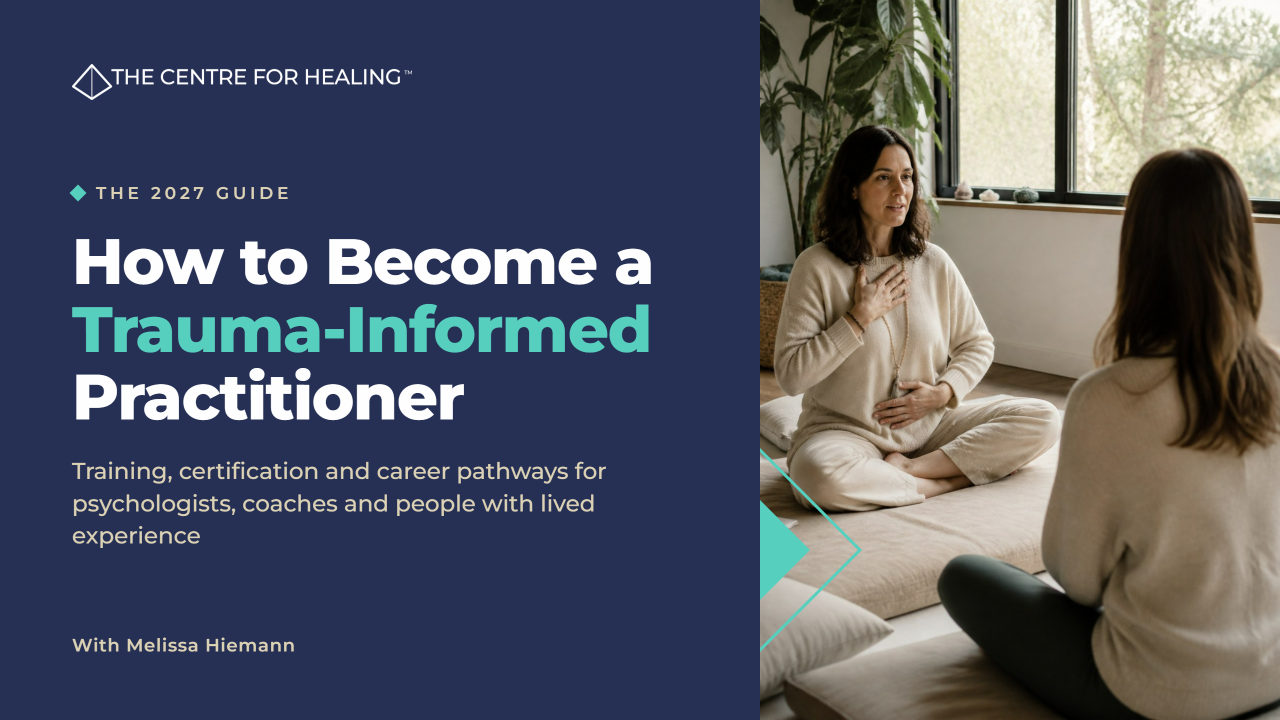
A complete guide to training, certification and career pathways for psychologists, counsellors, coaches and people with lived experience
By Melissa Hiemann, co-founder of The Centre for Healing and creator of Root-Cause Therapy
Maybe you've been through your own healing and something in you is saying, I want to do this for other people.
Maybe you're a coach, and you keep meeting clients who know exactly what they want, and something underneath keeps pulling them back.
Or maybe you're a psychologist or counsellor, and you've reached the edge of what talking can do. Your clients understand their story perfectly and still can't shift it.
Either way, you've probably found that the world of trauma training is confusing. There are degrees, certificates, modalities with acronyms, and a lot of big promises. It's hard to know what's real, what's recognised, and what will actually help you help someone.
I've been doing this work for over a decade. I ran an outpatient addiction and mental health clinic in Melbourne for four and a half years before we took our training online, and today our practitioners work in over 40 countries. I also came to this work as a client first. So I've seen it from both sides of the room.
This guide is everything I'd want someone to tell me if I was starting today. Whether you study with us or someone else, I hope it helps you choose well.
The short answer: the main pathways into trauma-informed work
There are four main ways to become a trauma-informed practitioner. Which one fits depends on what you want to do, who you want to work with, and the qualifications you already hold.
- A university degree in psychology, counselling, social work or a related field. This is the route to a clinical career. In Australia, you must be registered with the Psychology Board of Australia to call yourself a psychologist.
- A clinician-only trauma modality, such as EMDR, which is generally open only to registered or licensed mental health professionals.
- A short trauma-informed certificate. This gives you a trauma-informed lens for coaching, teaching, health care or leadership, without training you to facilitate deep healing sessions.
- A practitioner certification in a complementary modality, such as a somatic, regression or trauma-informed coaching method. This trains you to run structured sessions as a complementary practitioner, alongside medical and psychological care rather than instead of it.
Whichever route you take, finishing a course is only one part of being ready to practise. You'll also need to work within the law where you live, hold suitable insurance, and stay within the limits of your own training and competence. I'll explain each of those below.
What does a trauma-informed practitioner do?
A trauma-informed practitioner is someone who understands how trauma can affect the mind, the body and the nervous system, and who works in a way that keeps clients feeling safe, respected and in control.
It's worth knowing there are really two levels to this.
Trauma-informed means you understand trauma well enough not to cause more harm. You recognise when someone is dysregulated, you don't push, you offer choice, and you know when to refer on. Teachers, nurses, yoga instructors, HR managers and coaches can all be trauma-informed.
Trauma-focused work goes a step further. Here you're trained in a specific method to help a client work with what's underneath their symptoms. That's what most people mean when they say they want to become a trauma-informed practitioner.
In practice, the work usually looks like this:
- Helping clients understand why they react the way they do, without shame
- Supporting the nervous system to feel safe enough to meet what was never processed
- Exploring where a pattern began, not just managing the symptom
- Working alongside doctors, psychologists and other supports, never instead of them
The people who come to this work are often coaches, counsellors, kinesiologists, nurses, social workers, hypnotherapists and wellness practitioners. And a lot of them, like me, are people with lived experience who want to turn what they've been through into something meaningful.
Do you need to be a qualified therapist to study trauma-informed modalities?
To study most somatic and complementary modalities, no.
Many of the most effective trauma practitioners I know didn't start with a psychology degree. They started with their own healing, a big heart, and a willingness to learn properly and practise.
But studying a modality and practising it with the public are two different things. Here's what to be clear on.
Protected titles in Australia
In Australia, psychologist is a protected title under the Health Practitioner Regulation National Law. It is an offence to call yourself a psychologist unless you are registered with the Psychology Board of Australia, and anyone can check a practitioner's registration on the Ahpra public register.
Counsellor and psychotherapist are not protected titles under the National Registration and Accreditation Scheme. Counselling and psychotherapy are self-regulated professions in Australia. Professional standards are set by peak bodies such as the Australian Counselling Association (ACA) and the Psychotherapy and Counselling Federation of Australia (PACFA), and many employers and insurers look for membership of one of them.
Not being nationally registered doesn't mean anything goes. In most states and territories, health care workers who aren't registered under the National Scheme must follow a code of conduct for health care workers, enforced by the local health complaints body. Consumer law also applies to how you describe and advertise your services. A complementary therapy certification doesn't make you a psychologist, and it should never be presented as if it does.
If you practise outside Australia, the rules are different again. I cover the USA, UK, New Zealand and Europe in training and practising outside Australia below.
Scope of practice: what a certificate does and doesn't give you
Completing a certification tells you, and your clients, that you have finished a training and met its assessment requirements. On its own, it doesn't establish:
- Legal permission to practise in every country, state or setting, or to use every title
- Insurance. Each insurer and professional body sets its own criteria
- Competence with every client. Some presentations need clinical care first or alongside, such as an acute mental health crisis, psychosis, immediate risk of self-harm or recent hospitalisation
A good training will teach you exactly where your scope sits: not diagnosing, not treating medical or mental health conditions, screening clients at intake, and knowing when a client needs a GP, psychiatrist or psychologist as well as, or instead of, your sessions. Where a client has a diagnosed condition or is in active treatment, a complementary practitioner works alongside their treating clinician.
Enrolment eligibility vs practice eligibility
This is where a lot of people get confused, so here it is plainly.
Who can enrol is decided by the training provider. Our Root-Cause Therapy, Embodied Processing and Trauma-Informed Manifestation Coaching trainings have no prerequisites, so anyone can enrol.
Who can practise, and with what cover, is decided by others: the law where you work, your insurer or professional body, and your own scope and competence. For example, membership and insurance with the International Institute for Complementary Therapists (IICT) for Root-Cause Therapy or Embodied Processing requires a prior qualification in counselling, mental health, social work, health care, psychotherapy or tertiary mental health training. Graduates without one have two options. They can first certify in our Somatic Release Breathwork training, which gives them IICT membership and insurance and also opens IICT cover for Root-Cause Therapy and Embodied Processing (more on that below). Or they can take out professional indemnity insurance with another insurer that covers complementary practitioners.
If you already work with clients, a trauma-informed modality can sit alongside what you do now. If you're starting from scratch, look for a training that's genuinely step by step and builds in supervised practice.
Which path fits you? Psychologists, coaches and lived experience
The right training depends on where you're starting from. Here's how I'd think about it for the three groups who come to us most.
If you're a psychologist or counsellor
You already have the clinical foundations: assessment, ethics, risk and a deep understanding of mental health. What many psychologists and counsellors tell us they're missing is a practical way to work below the thinking mind, with what's felt in the body and the nervous system.
- It sits alongside what you already do. A somatic or regression method adds to your toolkit. You stay within your own registration, scope and professional obligations, and you decide how a new method fits your clinical judgement.
- Insurance is often simpler for you. A counselling, psychology or mental health qualification meets the IICT's prerequisite for membership and insurance for Root-Cause Therapy and Embodied Processing. If you're already insured, check with your current insurer whether a new modality is covered.
- CPD. Root-Cause Therapy (96 CPD credits) and Embodied Processing (80 CPD credits) are Accredited Activities with The CPD Group, and you can verify both on The CPD Register. Your board or association decides what counts towards your own CPD requirements, so check with them.
- Session length matters. Embodied Processing sessions usually run around an hour, so they fit a standard appointment. A first Root-Cause Therapy session takes 2 to 3 hours, so it suits practitioners who can offer longer sessions or intensive programs.
If you're a coach
Coaching moves people forward. But when there's trauma underneath, the same goal can keep stalling, and the client often blames themselves for it.
So many coaches who come through our trainings tell us the same thing: we were told not to work with trauma. The reality is, trauma can walk into any coaching session whether we name it or not. What we don't understand, we fear. What we understand, we can approach with care.
- Start with a trauma-informed lens. Our free Trauma-Informed Certificate for Coaches carries 20 CPD points and teaches you to recognise trauma responses, keep clients safe and know when to refer on.
- Then add tools for the blocks. Trauma-Informed Manifestation Coaching gives you a structured coaching method for working with the beliefs and nervous system patterns that can hold goals back. The program is approved by the International Coaching Federation (ICF) for 22 CCE units, including 13 Core Competency and 9 Resource Development hours.
- Go deeper when you're ready. Many coaches go on to add Root-Cause Therapy or Embodied Processing so they can work with where a pattern began, not just its symptoms. Coaching remains coaching, though: these trainings don't turn a coach into a clinician, and the referral skills matter even more.
If you have lived experience
Many of the best practitioners I know came to this work because they needed it first. That includes me. Ryan Hassan, my co-founder, came through addiction and anxiety himself, and Matt Kay, who co-created Embodied Processing with Ryan, also brings his own lived experience to the work.
Lived experience is a real gift in this work. Your clients can feel that you've been there. It also needs a structure around it, so your story becomes a resource for your clients rather than a map you project onto them.
- A clear method, so every session has a framework rather than relying on what worked for you
- Supervised practice, giving and receiving sessions before you ever see a paying client
- Your own ongoing healing. Our certifications have you receive sessions as well as give them, because your own material can come up, and having support for it is part of the work
You don't need a degree to enrol in Root-Cause Therapy, Embodied Processing or Trauma-Informed Manifestation Coaching. If you don't hold a mental health qualification, the main things to plan for are insurance and scope. Certifying first in Somatic Release Breathwork meets the IICT's requirement, so the IICT can then cover you for Root-Cause Therapy and Embodied Processing too. Other insurers also cover complementary practitioners, and we can point you to options in your country. For Embodied Processing, we recommend pairing it with another qualification, such as coaching, yoga, massage or counselling, for insurance purposes.
Training and practising outside Australia: the USA, UK, New Zealand and Europe
All of our trainings are fully online, and our practitioners work in over 40 countries, including the USA, the UK, New Zealand, Canada and across Europe. You can study from anywhere, practise with students in your own time zone, and join the live calls or watch the replays.
What changes from country to country is the practising side: which titles you can use, and how you get insured.
Choosing your title
Every country, and in the USA every state, has its own rules about professional titles. In the USA, words like "therapist", "therapy" and "counselor" are often tied to state licensing, so many of our US practitioners describe themselves as a practitioner or coach instead. Our UK practitioners mostly do the same. Before you choose your title or write your website, check the rules with the regulator where you live.
Two ways to get insured
1. Start with Somatic Release Breathwork. Our Somatic Release Breathwork Practitioner Training is accredited by the IICT for membership and insurance, and by IAOTH and ICAHP. The IICT has insurance partners in Australia, New Zealand, the United States, Canada, the United Kingdom, Europe (EEA) and South Africa. Once you're certified in breathwork and an IICT member, the IICT can also cover you for Root-Cause Therapy and Embodied Processing, even without a prior tertiary qualification. That makes breathwork a practical first step for many international students, and it's a beautiful modality to bring into sessions in its own right. As with any insurance, read your policy details for your country.
2. Take out your own professional indemnity insurance. Many of our practitioners around the world are insured directly through an insurer in their own country that covers complementary practitioners. Your certificate and course outline are usually what an insurer asks to see, and we're happy to send you both. Once insured, you can see clients locally and online.
Either way, insurance sits alongside the other parts of being ready to practise: following the law where you work and staying within your scope.
See where our practitioners are
Our Practitioner Directory lists certified Root-Cause Therapy, Embodied Processing and Trauma-Informed Manifestation Coaching practitioners around the world, in person and online. It's a good way to see how others in your country describe their work, and you're welcome to book a session with one of them to feel the work in your own body before you train.
Understanding somatic therapy and root-cause approaches
Here's the pattern I see over and over.
Someone has done the courses. They've read the books. They can explain their own patterns better than most people can explain the weather. And they're still doing the thing.
That's not a willpower problem, and it's not a them problem. Insight lives in one part of the mind. The pattern often runs somewhere deeper, sometimes from before they even had words for it.
That's why so many trauma-informed approaches now go beyond talking.
Top-down and bottom-up
Top-down approaches work through the thinking mind: insight, understanding, reframing. Talk therapy and coaching often work this way, and they have real value. Sometimes we do just need to talk things out with someone safe.
Bottom-up approaches work through the body and nervous system. Many trauma clinicians and researchers describe how stress responses that never got to complete can stay active in the body long after the event. Bottom-up methods help the body notice those responses safely and let them settle.
What is somatic therapy?
Somatic means "of the body". Somatic approaches help clients notice sensation, regulate their nervous system and feel emotion that may have been held back, sometimes for decades. Breathwork, tapping and Embodied Processing are all examples.
What is a root-cause approach?
When we get triggered, it can feel like we time travel back to the age that hasn't been healed yet. That's why a grown adult can suddenly feel, and react, like a scared little kid.
A root-cause approach explores where a pattern began and gives what wasn't processed at the time a chance to process now. For many clients, that loosens the hold the pattern has on their thoughts, behaviours and reactions.
Root-Cause Therapy, the method I created, uses regression and progression to do this, with the client in control the whole way.
The most effective practitioners I know understand both. They can help the body feel safe, and they can help the mind find where it all started.
What the evidence does and doesn't say
I'd rather be straight with you here. The thinking behind our methods draws on well-known work, including the Adverse Childhood Experiences research, attachment theory, Peter Levine's work on how the body responds to threat, Stephen Porges' polyvagal theory and Bessel van der Kolk's The Body Keeps the Score. Some of these ideas are well supported and some are still debated.
There are no published independent studies evaluating Root-Cause Therapy or Embodied Processing specifically. What we do have is a decade of clinical work, thousands of client sessions, and in RCT a Testing Sheet where clients rate things like stress, anxiety and sleep at every session, so change can be tracked over time. Results vary from person to person, and no method can promise a particular outcome.
Comparing different trauma-informed training pathways
There's no single right path. Here's an honest overview.
| Pathway | Best suited to | What it equips you for |
|---|---|---|
| University degree (psychology, counselling, social work) | People wanting a clinical career | Clinical assessment and therapy, usually after several years of study; registration as a psychologist requires further steps set by the Psychology Board |
| Clinician-only modality training (e.g. EMDR) | Registered or licensed mental health professionals | Adding a specialised trauma method to an existing clinical practice |
| Short trauma-informed certificate | Coaches, educators, leaders, support workers | Working more safely with people who have trauma, without facilitating deep healing sessions |
| Practitioner certification in a complementary modality | Coaches, healers, wellness professionals, clinicians adding skills, and people with lived experience | Running structured sessions as a complementary practitioner, within your scope and alongside medical and psychological care |
Everyone needs a different kind of support at a different time, and every one of these has its place. Many of our students already hold a degree or another modality and add a somatic or root-cause method because it gives them the missing piece.
Choosing an accredited or professionally recognised course
This is the question I get asked most: is it a real qualification?
Most somatic and complementary modalities aren't government-registered professions, so recognition comes from independent professional bodies and CPD providers. That's normal for this field. It's also worth knowing what each kind of recognition means, because they're not the same thing:
- Professional body accreditation or approval, such as the International Association of Therapists (IAOTH), International Compliance Assurance for Holistic Practitioners (ICAHP) or the International Institute for Complementary Therapists (IICT). These bodies review training against their own criteria and may offer graduates membership and access to insurance, often with their own eligibility rules.
- CPD accreditation, such as an Accredited Activity with The CPD Group. This confirms the training meets CPD standards and is listed on The CPD Register, where you can check it yourself. It counts towards professional development hours; it isn't a licence to practise.
- Coaching education approval, such as ICF Continuing Coach Education (CCE). This lets credentialed coaches count the hours towards renewing their ICF credential.
- Government registration, such as Ahpra registration for psychologists, which no short course can give you.
When you're comparing courses, check whether the recognition can be verified, what it actually covers, and whether your existing association or insurer accepts it. If a course can't tell you clearly who it's recognised by, or you can't verify it, that's worth noticing.
What to look for in online practitioner certification
Online training has come a long way. Done well, it can be just as practical as in-person training, and it means you can learn from anywhere, around your work and family.
But not all online certifications are created equal. Before you enrol, I'd check for these:
- Real practice, not just theory. You should give and receive sessions before you're certified. That's where the confidence comes from.
- Assessment of your actual work. Someone should review your sessions or session notes and give you feedback, not just tick a quiz.
- Live supervision. Regular live calls where you can bring real questions about real clients.
- Filmed demonstrations. Watching a full session from start to finish teaches you things no worksheet can.
- A clear session framework. You should always know where to go next in a session.
- Safety protocols. Look for specific guidance on dissociation, complex trauma, intake screening and when to refer on.
- Community. Peers to practise with and learn alongside, long after you finish.
- Business training. If you want to do this work full-time or part-time, you need to know how to find clients and run a practice ethically.
- Lifetime access and updates. Good methods evolve, and you should evolve with them.
- Honesty about scope. A good training tells you who it's not for, and is upfront about what you can and can't call yourself.
And one more, which is harder to measure. Look for trainers who have done the work themselves. People can feel the difference between someone who studied this and someone who lived it.
Training pathways offered by The Centre for Healing
The Centre for Healing is a global online school for trauma-informed somatic practitioners. We started as an in-person addiction and mental health clinic in Melbourne in 2016, and more than 100,000 people have now taken our online courses.
Here's where most people start.
Root-Cause Therapy Practitioner Certification
Root-Cause Therapy (RCT) is a step-by-step regression method for exploring where a pattern began and working with it at its origin. It's the framework we used with clients in our clinic for years, and the one I wrote the book on.
- Nine modules and over 75 video lessons, including four filmed sessions following one client from start to finish
- The RCT Testing Sheet, a clear framework for every session
- Monthly live support and supervision with me, recorded for replay
- Certification assessed on real sessions: you give at least six and receive at least three, then I personally review your Testing Sheets, session notes and client feedback forms
- Accredited with IAOTH and ICAHP, registered as a professional development course with the IICT, and an Accredited Activity with The CPD Group for 96 CPD credits
- Business training, client intake forms and a Practitioner Directory listing once certified
- No prerequisites to enrol, lifetime access, and a payment plan
RCT sessions are deep and take time, around 2 to 3 hours for a first session and 90 minutes to 2 hours after that. It suits practitioners who can offer longer appointments. Practice sessions aren't observed live; individual feedback comes through my review of your work and the supervision calls.
Watch the free Root-Cause Therapy Pre-Training
Explore the Root-Cause Therapy Certification
Embodied Processing
Embodied Processing (EP) is our bottom-up, somatic approach to working with chronic stress and nervous system dysregulation. It was co-created by my co-founder Ryan Hassan and Matt Kay, a somatic psychotherapist who has worked in private practice and in drug and alcohol rehabilitation, out of their own lived experience, years of training and many client sessions. Psychologist and Gestalt therapist Noel Haarburger also teaches on the live calls.
Where Root-Cause Therapy goes back to where a belief began, EP works with what's happening in the body right now. It describes trauma as an adaptation of the nervous system rather than a disorder. EP builds a felt sense of safety first, then helps the client gradually meet sensations and emotions that felt too much at the time, at a pace their nervous system can manage. It's a blend of talking and feeling, and the balance shifts with each client.
EP pays particular attention to developmental, attachment and relational trauma, the slow-building kind that shapes how a person's sense of self and nervous system formed. It also teaches how to work with the effects of acute or shock experiences.
How an EP session flows
- Open the session and determine what's to be explored
- Ground the client in a resource of safety before going anywhere near the wound
- Invite in the trigger and move from the thinking mind down into the body
- Discern the emotion and explore its origins
- Use processing techniques to help the body digest what's been held
- Find resolution and completion, with emergency measures for anything big that arises
EP draws on, and is inspired by, approaches including Somatic Experiencing, Stephen Porges' polyvagal theory, the NeuroAffective Relational Model (NARM), Internal Family Systems, Compassionate Inquiry and the Diamond Approach. Like Internal Family Systems, it works with parts of the self, but with constant tracking of body sensation. It isn't a replacement for any of those trainings. Our biggest teachers, though, have been the clients themselves.
What's in the training
- Around 40 hours of self-paced theory across nine modules, covering trauma, the nervous system and polyvagal theory, emotions, the unconscious, addiction and the full EP session process
- Monthly live Q&A calls with Ryan, Matt and Noel, plus weekly study and practice groups, all recorded
- A minimum of around 40 hours of practice: giving 15 and receiving 15 sessions with fellow students, plus at least one paid session from a trainer, senior or certified practitioner
- Certification through a recorded assessment session reviewed by an EP trainer, who either certifies you or tells you what to work on
- An Accredited Activity with The CPD Group for 80 CPD points, and approved by the IICT for membership and insurance for graduates with a prior tertiary qualification
- Lifetime access and a student community to practise with
Most practitioners certify in 4 to 6 months. EP sessions usually run around an hour and are mostly held online, so EP fits well into standard appointments. That makes it a natural fit for psychologists, counsellors, social workers, nurses, bodyworkers and yoga teachers who want somatic skills they can use within their existing scope.
Watch the free Embodied Processing masterclass
Trauma-Informed Manifestation Coaching
Trauma-Informed Manifestation Coaching (TIMC) is the coaching method I created to bring trauma awareness into manifesting. A lot of manifestation advice asks people to think positive over the top of their pain. TIMC takes a different approach.
It helps clients get clear on what they truly want, then works with the unconscious beliefs, emotions and nervous system patterns that can make it feel unsafe to have it. If part of you doesn't feel safe or worthy of something, a vision board alone usually won't override that.
The tools you'll learn
- Future Self guided meditation, so clients meet the version of themselves who has already reached the goal and receive their guidance
- Alignment Numbers, where clients rate how safe, worthy, deserving and trusting they feel about a goal, then somatically process what's in the way
- Belief planting and vision boarding, to anchor new beliefs and give clients something to come back to
- Journaling and processing practices clients can use between sessions, so they're not dependent on you
- Akashic Records readings, for those of you who resonate with the more spiritual side of this work
What's in the training
- Around 16 hours of self-paced video lessons, with worksheets, scripts and session demonstrations
- Monthly live group Q&A and coaching calls with me
- A four-session program structure you can offer clients, with sessions of 45 to 60 minutes
- Approved by the International Coaching Federation (ICF) for 22 CCE units, including 13 Core Competency and 9 Resource Development hours, and recognised by IAOTH and ICAHP
Most students certify in 2 to 3 months. TIMC is a coaching method, so TIMC coaches don't treat trauma or mental health conditions. You'll learn to work safely with what comes up and to refer on when a client needs more. It's a good fit for coaches, and for practitioners who want a shorter session format focused on money, relationships, health and business goals.
Watch the free TIMC introductory training
Explore Trauma-Informed Manifestation Coaching
Trauma-Informed Certificate for Coaches (free)
If you're a coach, educator, health professional or manager who wants a trauma-informed lens without learning a healing modality, this is the place to start. It's a free, self-paced video course with short assessments, taught by Ryan and Matt, and carries 20 CPD points.
It covers types of trauma, the neuroscience of trauma, holding space and attunement, emotions, and how trauma shapes beliefs and behaviour. It's an educational course rather than a trauma healing training, and its topics are covered in much more depth inside Embodied Processing.
Get the free Trauma-Informed Certificate for Coaches
Somatic Release Breathwork
Somatic Release Breathwork (SRB) trains you to facilitate one-to-one and group breathwork sessions that help clients feel, regulate and release what's held in the body. It's a powerful practice in its own right, and it pairs naturally with Embodied Processing and Root-Cause Therapy.
- Around 30 hours of self-paced theory, 40 hours of practice and 10 hours of live calls
- Most students take 4 to 6 months to qualify to facilitate both one-to-one and group breathwork
- Sessions run for 60 to 90 minutes on average, one-to-one or in a group
- Certification through giving and receiving practice sessions, a daily personal practice, live group calls and a recorded assessment session reviewed by the trainer
- Accredited by the IICT for membership and insurance, and by IAOTH and ICAHP
- Once you're an IICT member through breathwork, the IICT can also cover you for Root-Cause Therapy and Embodied Processing, even without a prior tertiary qualification
That last point makes breathwork a smart first certification if you don't hold a mental health qualification, or you're practising outside Australia.
Explore Somatic Release Breathwork
The three certifications side by side
| At a glance | Root-Cause Therapy | Embodied Processing | Trauma-Informed Manifestation Coaching |
|---|---|---|---|
| Approach | Regression to where a belief or pattern began | Bottom-up somatic work with the nervous system | Trauma-informed coaching towards a goal |
| Taught by | Melissa Hiemann | Ryan Hassan and Matt Kay, with Noel Haarburger | Melissa Hiemann |
| Typical session | 2 to 3 hours first, then 90 minutes to 2 hours | Around 1 hour | 45 to 60 minutes |
| Average time to certify | 3 to 4 months | 4 to 6 months | 2 to 3 months |
| Recognition | IAOTH, ICAHP, IICT (professional development), 96 CPD credits | IICT, ICAHP, 80 CPD points | ICF 22 CCE units, IAOTH, ICAHP |
| Prerequisites to enrol | None | None | None |
| IICT insurance | Requires a prior mental health or related qualification, or Somatic Release Breathwork certification | Requires a prior tertiary qualification, or Somatic Release Breathwork certification | Not covered by IICT |
| Especially suits | Practitioners offering longer sessions or programs | Psychologists, counsellors and bodyworkers in standard appointments | Coaches and goal-focused practitioners |
There's no wrong order. Many of our practitioners train in two or all three, and what you pay for Root-Cause Therapy can be credited towards the Practitioner Bundle, which brings all three together.
Adding to your toolkit
Once you've trained in one of the above, many of our practitioners add complementary skills such as Somatic Acupoint Tapping, Somatic Release Breathwork, Trauma-Aware Parenting and trauma-informed meditation. If you're outside Australia, or don't hold a mental health qualification, starting with breathwork opens the IICT insurance route for your other certifications.
See all our trainings or see CPD and CCE points by course
Not sure where to start?
Each of our three main certifications has a free introductory training, so you can feel the method before you decide. If you're drawn to going back to where a pattern began, start with Root-Cause Therapy. If you want somatic skills for standard-length sessions, start with Embodied Processing. If you're a coach, start with Trauma-Informed Manifestation Coaching. Not sure? Watching two of them side by side usually makes it clear.
You can also download our free Practitioner Pathway Planner. It has a short quiz to find your best-fit modality, what your background means for titles and insurance, and a readiness checklist. And if you'd rather talk it through, book a call with me or Ryan.
- Free Root-Cause Therapy Pre-Training: what RCT is, how we explain trauma and its symptoms, and how a practitioner works out what to focus on with a client
- Free Embodied Processing masterclass: how trauma can show up in the body, and what safe somatic work looks like in practice
- Free TIMC introductory training: how trauma affects manifestation, and why we can hold back from big goals
Frequently asked questions from prospective students
How long does it take to become a trauma-informed practitioner?
It depends on the pathway. A university degree takes several years. Our practitioner certifications are self-paced, and on average our students certify in 3 to 4 months for Root-Cause Therapy, 4 to 6 months for Embodied Processing, 2 to 3 months for Trauma-Informed Manifestation Coaching and 4 to 6 months for Somatic Release Breathwork. Many fit it around work and family.
Can I study trauma-informed therapy online from anywhere in the world?
Yes. All of our trainings are fully online, with live calls you can join or watch on replay. Our practitioners are in over 40 countries, including the USA, UK, New Zealand, Canada and across Europe. The rules for practising, including which titles you can use, vary by country and state, so check where you live.
How do I get insured as a practitioner in the USA, UK, New Zealand or Europe?
There are two common routes. You can certify in Somatic Release Breathwork, which is accredited by the IICT for membership and insurance. The IICT has insurance partners in Australia, New Zealand, the USA, Canada, the UK, Europe (EEA) and South Africa, and once you're an IICT member through breathwork it can also cover you for Root-Cause Therapy and Embodied Processing. Or you can take out professional indemnity insurance with an insurer in your own country that covers complementary practitioners.
Do I need any experience or qualifications to start?
Not to enrol. There are no prerequisites for Root-Cause Therapy, Embodied Processing or Trauma-Informed Manifestation Coaching. If you have an empathic heart and want to help people, you can start. Your existing qualifications do affect which insurers will cover you once you're certified, and what you can call yourself.
Will I be able to see clients once I'm certified?
Many of our graduates do. Certification shows you've completed the training and met its assessment requirements. Before you see paying clients, you'll also need suitable professional indemnity insurance, to follow the laws and codes of conduct where you practise, and to work within your scope, referring on when a client needs clinical care.
Is counsellor a protected title in Australia?
No. Psychologist is a protected title under the National Law, and only people registered with the Psychology Board of Australia can use it. Counsellor and psychotherapist are not protected titles under the National Registration and Accreditation Scheme; those professions are self-regulated through bodies such as ACA and PACFA. Unregistered health care workers are still expected to follow the code of conduct that applies in their state or territory.
Can I claim CPD points with my professional association?
Root-Cause Therapy (96 CPD credits) and Embodied Processing (80 CPD points) are Accredited Activities with The CPD Group, and the Trauma-Informed Certificate for Coaches carries 20 CPD points. Trauma-Informed Manifestation Coaching is approved by the ICF for 22 CCE units, which credentialed coaches can put towards their ICF credential renewal. Each association makes its own decision on what counts, so check with yours. We're happy to send you a course outline to share with them.
Can psychologists and counsellors train in somatic and regression modalities?
Yes, and many do. These modalities add practical, body-based skills to the clinical foundations you already have, and you continue to practise within your own registration, scope and professional obligations. A counselling, psychology or mental health qualification also meets the IICT's prerequisite for membership and insurance for Root-Cause Therapy and Embodied Processing.
Which trauma-informed course is best for coaches?
Most coaches start with our free Trauma-Informed Certificate for Coaches for the foundations, then train in Trauma-Informed Manifestation Coaching, which is approved by the ICF for 22 CCE units. Coaches who want to work with where a pattern began often add Root-Cause Therapy or Embodied Processing, while keeping clear boundaries around what coaching can and can't hold.
Can I become a trauma-informed practitioner with lived experience and no qualifications?
Yes. Many of our best practitioners started exactly there. You'll learn a structured method, practise with supervision and receive sessions yourself before you certify. The main things to plan for are insurance and scope, as some insurers require a mental health qualification and others don't. We can point you to options in your country.
What's the difference between Root-Cause Therapy and Embodied Processing?
Root-Cause Therapy is belief-led: it tests which limiting beliefs are active, travels back to where they formed, lets the emotion be felt and released in the body, and reparents the younger self. Embodied Processing is bottom-up: it tracks sensation and emotion in the body in the present, building safety and helping the nervous system complete what it couldn't at the time. Many practitioners train in both and combine them.
Is it safe to work with clients who have complex trauma?
Safety always comes first, and some clients need clinical care before or alongside complementary work. A good training will teach you to screen at intake, work slowly, ground your client before going deeper, respect every no, and know exactly when to refer on. In RCT there's a dedicated protocol for complex trauma and dissociation.
Will my own trauma come up while I'm training?
It might. Learning about trauma, and giving and receiving practice sessions, can bring up your own experiences. Sometimes that feels like insight or relief. Sometimes it's simply distress, and that isn't proof that healing is happening, or that you should push through.
You stay in charge of your pace. You can pause, choose what you bring into practice sessions, step back from a module, and ask for support: from our trainers and senior practitioners, your own therapist or GP, or a crisis line if you need help urgently. Looking after yourself this way is part of the training, and it's part of what helps our practitioners hold space safely for others.
What's the difference between trauma-informed and trauma-focused?
Trauma-informed means understanding trauma well enough to work safely and avoid causing harm. Trauma-focused means being trained in a method to actively help clients work with trauma and its effects. Our practitioner certifications cover both, within the scope of a complementary practitioner or coach.
If you'd like to hear Ryan and Matt unpack what trauma-informed really means in practice, watch their free class: What trauma-informed practice actually requires.
How much does it cost?
A practitioner certification costs a fraction of a university degree, and we offer monthly payment plans. Our paid trainings also come with a money-back guarantee: you can request a full refund within 7 days of enrolling, as long as you've completed less than 25% of the course. Trauma-Aware Parenting has its own 14-day guarantee. The full terms are on our support page, and you can see current pricing on each course page.
What you've been through isn't a detour
So many of our best practitioners came to this work because they needed it first.
None of what you went through was your fault. And it can become the very thing that lets you sit with someone else in theirs, because you remember what it felt like, and you know there's a way through.
If something in you is saying yes, I'd love for you to start with one of our free trainings.
Register for the free Root-Cause Therapy Pre-Training
Watch the free Embodied Processing masterclass
Not sure which path is yours yet? Get the free Practitioner Pathway Planner, or book a call with me or Ryan if you have more questions.
Thank you for being here.
Mel
About the author
Melissa Hiemann is the co-founder of The Centre for Healing and the creator of Root-Cause Therapy and Trauma-Informed Manifestation Coaching. In 2016 she co-founded the centre with Ryan Hassan as an in-person outpatient addiction and mental health clinic in Melbourne, where her team delivered thousands of client sessions before moving the training online. She trained in NLP, Time Line Therapy and hypnotherapy, and she teaches the ICF-approved Trauma-Informed Manifestation Coaching program. Melissa is the author of The Natural High and the Root-Cause Therapy book, and she brings her own lived experience of trauma and recovery to everything she teaches. Today she trains and supervises practitioners in over 40 countries.
References and further reading
Regulation and protected titles in Australia
- Ahpra, Frequently asked questions: protected titles under the National Law
- Psychology Board of Australia, Understanding title protection and scope of practice
- Australian Government Department of Health, National standards for counsellors and psychotherapists: summary report (October 2025)
- Psychotherapy and Counselling Federation of Australia (PACFA), Fact sheet: the self-regulating profession of counselling and psychotherapy
- Victorian Department of Health, National Code of Conduct for health care workers
Accreditation and professional recognition
- The CPD Register, Root-Cause Therapy Practitioner Certification, activity #1005554
- The CPD Register, Embodied Processing, activity #1008743
- The CPD Register, The Centre for Healing, provider #778168
- International Institute for Complementary Therapists (IICT), Embodied Processing membership and insurance
- International Compliance Assurance for Holistic Practitioners (ICAHP), The Centre for Healing, accredited holistic training provider
- IICT, Countries IICT services
- IICT, Breathwork membership and insurance
- International Association of Therapists (IAOTH), iaoth.com
- International Coaching Federation (ICF), Continuing Coach Education (CCE)
Want to go deeper?
Start with one of our free trainings, taught by the people who created the methods. Watch at your own pace.
Or dive into a short course or recorded workshop, self-paced with lifetime access.
Want to go deeper with Root-Cause Therapy?
Watch Melissa's free Root-Cause Therapy training, or read the whole method in her book.
Order the Root-Cause Therapy book
Or listen to the audiobook, read by Melissa: